La Chance is a furniture editor and design gallery founded in Paris in 2012 by Jean-Baptiste Souletie and Louise Breguet. To edit, for the house, means choosing a design, entrusting it to the workshop best able to serve it, and keeping it in the collection long enough for it to become a reference.

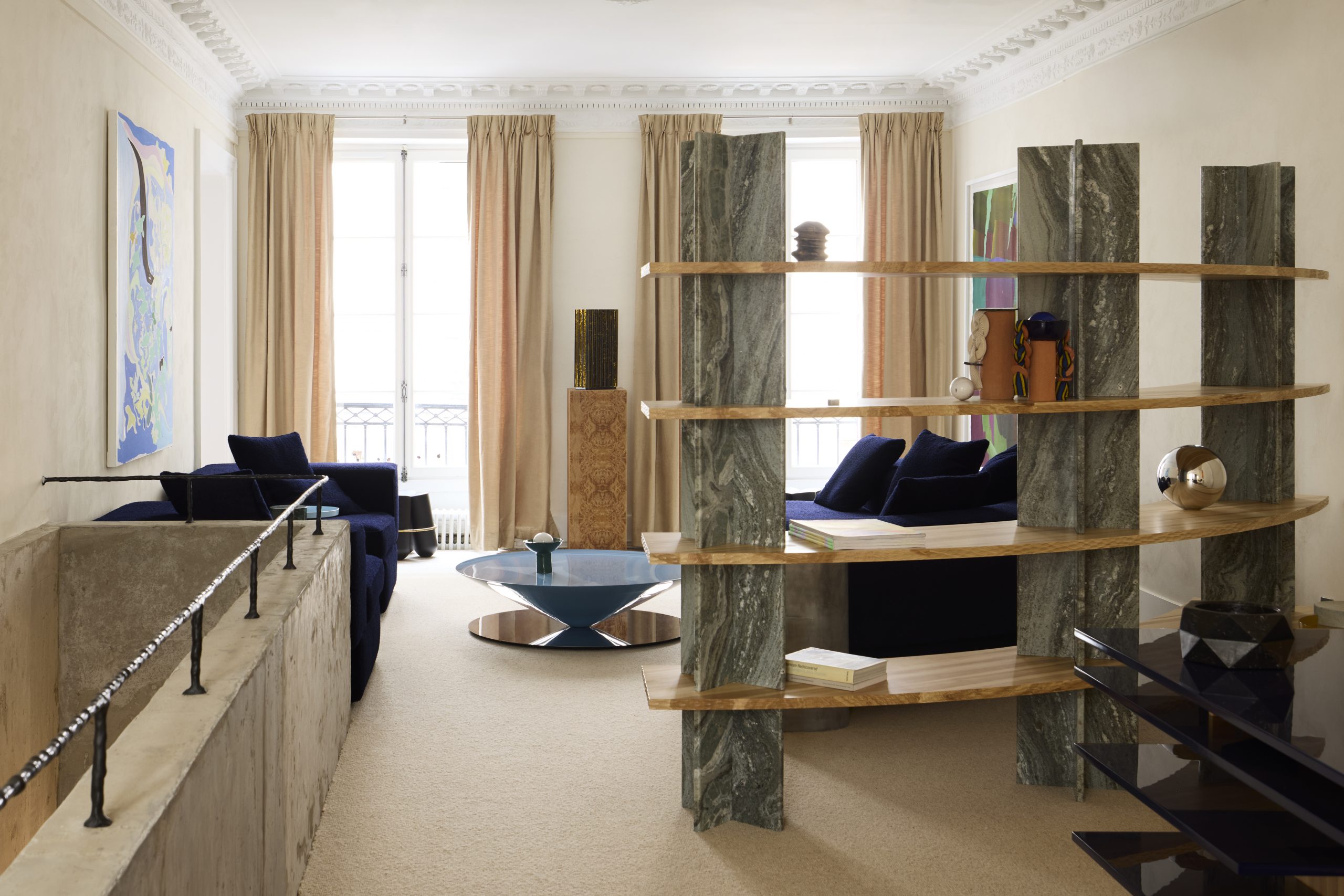
From the start, the house has held one position: furniture as sculptural volume, with mass, stacking and material as its vocabulary. Its references are openly claimed: Ruhlmann's ornament, the comfort of the 1970s, the directness of Brutalism, the colour of Memphis and Nathalie Du Pasquier.

That position runs across eras. It lives in the house classics, produced continuously since 2012, such as Noé Duchaufour-Lawrance's Borghese sofa and Sebastian Herkner's Salute tables; in reissues, from Ruhlmann in 2014 to Joseph-André Motte's Hexa 67 table, produced in 2026 with the Mobilier national; and in collaborations with emerging and established designers: Hannes Peer, Anthony Guerrée, Rudy Guénaire, Bernal & Semerciyan.

Louise Breguet and Jean-Baptiste Souletie, founders of La Chance, in the former La Chance gallery, rue de la Pierre-Levée, Paris 11th.

We shared a taste for geometric pieces, strongly built, almost architectural.

LA CHANCE WAS BORN IN 2012, WHEN JEAN-BAPTISTE SOULETIE MET LOUISE BREGUET.

Louise Breguet co-founded La Chance with Jean-Baptiste Souletie in 2012. An architect, she began her career in Beijing, worked on projects in France and Haiti, then opened her Paris practice in 2009; project after project, she settled on a comfortable, colourful vocabulary drawing on the 1980s. She kept from it a taste for workshops and building sites, and an architect’s conviction: an idea only truly exists in the real world, and it only gets there if you know how to coordinate the people who make it. At La Chance, she leads the technical development of the pieces and the relationship with our craftsmen and workshops.

Jean-Baptiste Souletie co-founded La Chance with Louise Breguet in 2012 and is its artistic director. He came from elsewhere: finance, at a private equity fund, then Kering. He kept from it a way of looking at a brand as a whole, from the drawing of a piece to the network that makes it known. But furniture goes back further: at fifteen, his bedside books were monographs on Ruhlmann and Eames. At La Chance, he chooses the designers, writes the briefs and holds the collection together; he also designs, among them the Planet chair, the Sunday tables and the Iris pendant.

Chance, and mutual friends, brought the two together. Through long conversations they set out the outlines and values of the brand: a bold furniture house rooted in the French tradition of decorative, ornamental furniture, producing sculptural pieces without ever neglecting comfort.

MILAN, 2012: THE FIRST COLLECTION, AMONG THE STEAM LOCOMOTIVES.

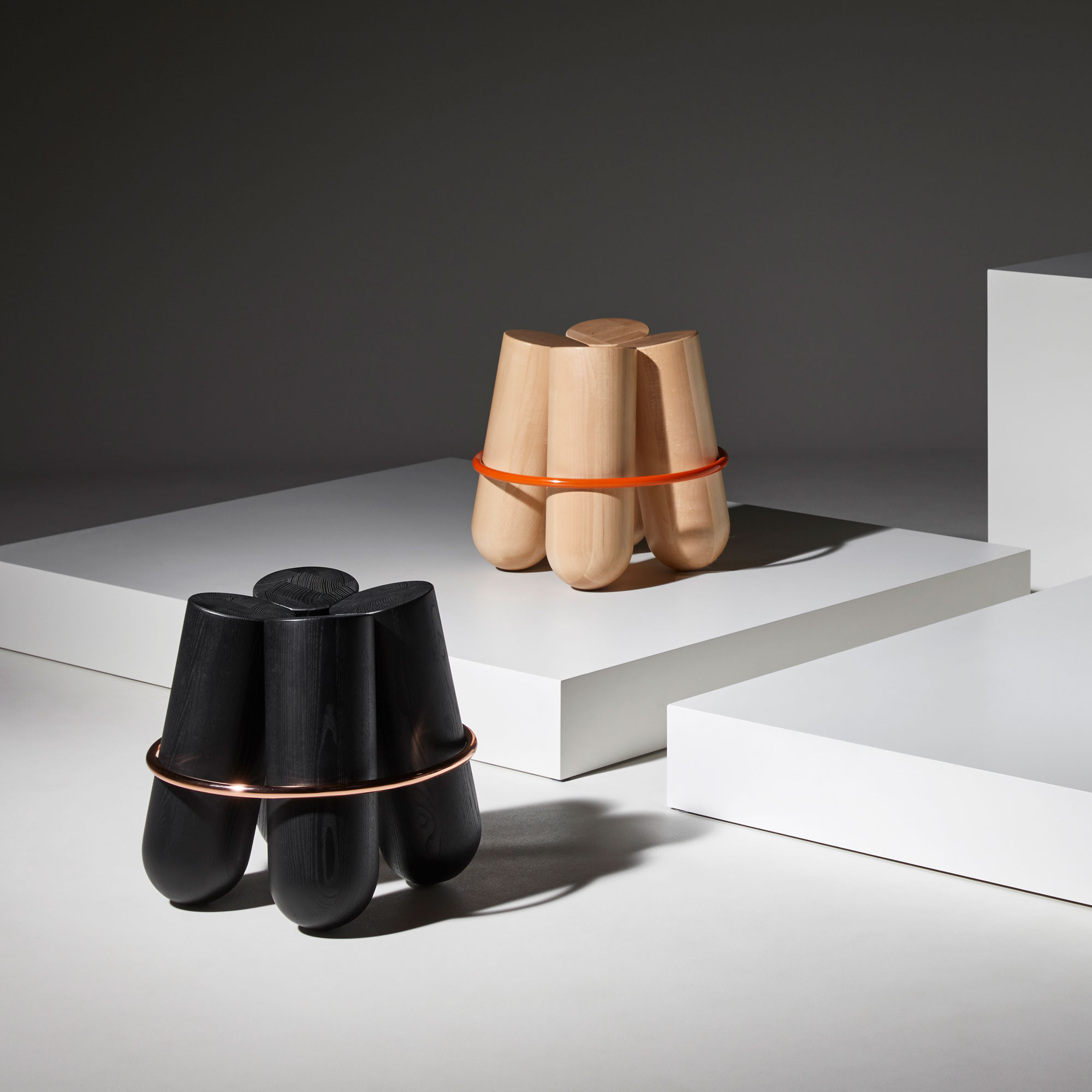
Noé Duchaufour-Lawrance, Luca Nichetto and Note Design Studio joined the project and designed for the first collection: twelve pieces, including the Borghese sofa, the Iconic mirror and the Bolt stool.

A journalist and curator urged the two partners to launch in Milan rather than Paris. Neither had ever been to the Salone del Mobile, and a stand seemed out of budget. Undeterred, one encounter led to another: Tom Dixon, who was opening an event that year at Milan’s science and technology museum, gave the duo their chance. The first collection was shown among the museum’s nineteenth-century steam locomotives and became one of the highlights of the 2012 Salone del Mobile.

Louise Breguet was 27 and Jean-Baptiste Souletie 28 when La Chance was launched.

Our first two clients were a department store in Hong Kong and an architect in Los Angeles.

A few months after Milan, the first pieces shipped to Hong Kong and Los Angeles. Today, La Chance pieces furnish residences and hotels in the United States, the Gulf, Asia and Australia, through a network of partner galleries and agents.

The collection grows through encounters. Each piece starts from a brief given by the house: the designer answers it in their own language, and the drawing is enriched by that meeting, from first sketch to prototype. Some designers published their first piece of furniture with La Chance; others, like Noé Duchaufour-Lawrance, have been there since the first collection.

“When we start a project, we first try to understand how the designer works. Then we show them the house’s position. We are an editor, but we have a style, and it is what holds the collection together.”

The conversation starts with the first ideas and sketches. Working within the production constraints of our European craftsmen then steers the drawing towards the finished piece: the marble back of the Ronin chair, the two bent aluminium sheets of the Phoenix chair and the steel frame of the Borghese sofa, welded branch by branch, all came out of it. “Every constraint is a pivot designers lean on, a pretext for creativity, and we never stop marvelling at how they manage to elevate a technique or a material.”

We keep our eyes wide open for new designers.

Over the past three years, La Chance has concentrated its work on the decorative arts. Pieces are made to order by our craftsmen, in workshops in France and Italy the house has worked with for years, built on trust and continuity. La Chance also develops its own materials: Murano glass recast to give new value to discarded pieces; alpaca fabrics sourced from Peru; and a jacquard developed with the Tissages de Charlieu for Contrepoint, Anthony Guerrée’s installation at the musée Bourdelle in September 2026.

The rugs come in two collections, one tufted, the other hand-knotted in cashmere, both made in India.

Every constraint is a pivot designers lean on.

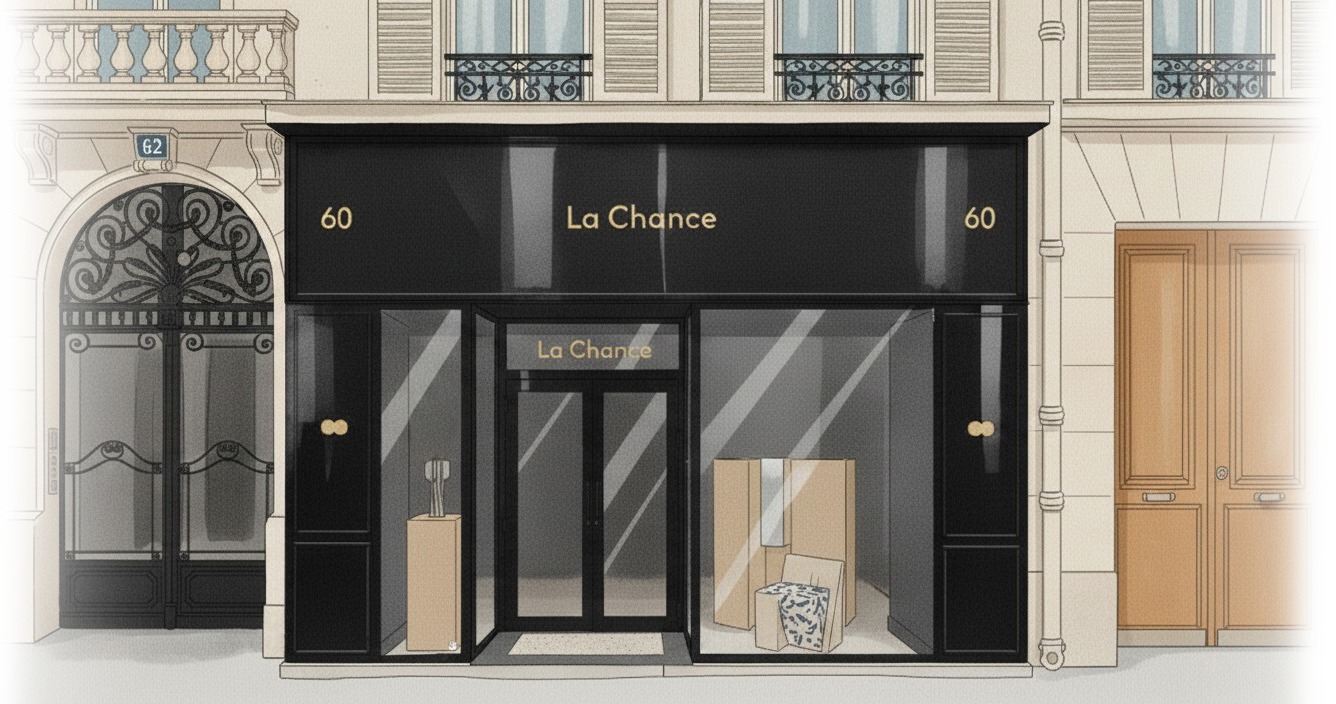
The opening in 2025 of the gallery at 60 rue de Richelieu, between the Palais-Royal and the Bibliothèque nationale, marked this transformation. The collection’s display spaces are brought together there with the design studio and the material library, open to architects, collectors and designers, by appointment. The neighbourhood is a lively one, where design galleries, fashion houses, fabric houses, and some of Paris’s best-known shops and restaurants sit side by side.

LA CHANCE GALLERY

60, rue de Richelieu
75002  Paris
by appointment
+33 (0)9 72 31 12 77

info@lachance.paris

By browsing this website, you accept the use of cookies for the purpose of producing visit statistics.

I agree
<